Miles and miles
View Miles and miles in a larger map

My documentary project on health care has picked up some pace and I am working with three people in the Charlotte and Monroe area currently. They all have very interesting, sad and disturbing stories about their struggle surviving major health injuries. Vernadine has a prosthetic leg and is more than 100,000 dollars in debt. Keith was diagnosed with tongue and throat cancer in November 2009 and went through 35 radiation treatments. His last bite of food was in November and he has been fed through his stomach ever since. Angie, 45, has been diagnosed with breast cancer two times and is still paying off debt from her treatments. All three individuals are on disability, however, the disability is not sufficient enough for them to support themselves without the help of friends and families. A book could be written about each one of them explaining their stories and how they got to where they are, but for now I’ll just show some photographs.
 Vernadine currently lives with her two sons and two grandsons in a two bedroom apartment.
 At one point, Vernadine was on more than 20 different medications. With the help of her son, she has replaced many medicines with vitamins and now takes less than 7 types of medicines a day. She suffers from high blood pressure, diabetes and lupus.
 “I was so angry, I was so angry. I don’t know who I was angry with, myself, god, the people that cut it [her leg off],” Vernadine said.
 “You can lose your house and you can lose your job and you can lose your shoe and whatever, but when you lose your health, you have lost a lot, a whole lot. Every now and then I can smile, I can still smile and go on and I just keep taking it one day at a time,” Vernadine said.
 Angie Miller plays with her three grandchildren, whom she currently has temporary custody of, after their nap time in Wingate, North Carolina.
 Allison is upset about having to clean up after play time. “I want to live as long as I can live, I want to see my grandchildren grow up, I want to enjoy life. So irregardless of what kind of debt I’m going to get into, I’m going to keep getting any kind of treatment that I need,” Angie said.
 Angie visits the hospital every three weeks to receive an IV that helps keep her cancer from returning.
 It takes about two hours for the IV treatment to be done. Angie must have this procedure done every three weeks for the rest of her life.
 Keith, foreground, walks by Angie, as she sleeps during her IV treatment. Keith and Angie receive treatment for their cancer from the same hospital in Monroe, North Carolina.
 Keith visits Dr. Troutman for a routine check up. Keith had all of his lymph nodes on the left side of his neck removed because of his cancer. One night Keith woke up covered in blood because the cut in his neck had filled with blood and burst open. He had to have a drain tube put in place for several weeks while the wound healed.
 Keith’s girlfriend, Sheryl, feeds Keith everyday through a tube in his stomach. While Medicaid paid for all of Keith’s cancer treatment, Keith receives $450 dollars per month for disability. When he was put on disability, his food stamps were cut in half. “I worked hard my whole life, six, seven days a week, I paid my dues, and to give me $449 dollars a month for disability, I think is a joke,” Keith said, who would be homeless without Sheryl allowing him to stay rent free at her home.
 Keith is on several medications to help him recover from his cancer treatment, which due to the type of cancer he had, was one of the most intensive chemo and radiation treatments the human body can withstand.
 “She has been by my side 24 hours a day, seven days a week since this started. She is an angel. And I could give her millions of dollars if I had it, but that still wouldn’t be enough to repay her for what she has done for me,” Keith said about Sheryl.
 “He has never complained. He has always been the most positive person throughout this treatment,” Sheryl said.
 Friends help Sheryl bag mulch from the counties local leaf dump while Sheryl takes a break to keep Keith smiling.
I’ve been working more in Charlotte on my project about health care. I’ve been narrowing my focus on the have-nots of health care, meaning those who are either under or uninsured. Most of my focus is on government programs, such as Medicaid and Medicare, and I would like to show where the programs are failing, as well as succeeding. The first photograph below is from a Tea Party protest at an intersection in Charlotte. The group waited at the intersection for President Obama to drive by after his visit to the Celgard plant in Charlotte to protest the recent passing of the health care bill. Tensions were high between pro-health reform, who stood on an opposite side of the intersection, and anti-health reform protesters.
There seems to be three groups, the Tea Party, Americans for Prosperity, and FreedomWorks, which overlap in some ways, that are funding and organizing these protests. It is interesting to see organized protest for a cause happening around the country, but it can be misleading. Who are the organizers of these protest and what are their motives? An article in In These Times about Dick Armey, a former opponent to HillaryCare in 1993 and current de-facto leader of the Tea Party, offers some interesting background information about Armey. There seems to be a difference in historical movements, such as the civil rights and women’s rights movements, than this new, extremely conservative, movement. Is a movement floating on a river of money from big business really a movement of the people?

The second image is from a gathering of Tea Party members in Raleigh to encourage members of the North Carolina Attorney General A.G. Roy Cooper to join other states “in a lawsuit against ObamaCare and stop the federal powergrab!” according to the Tea Party website.

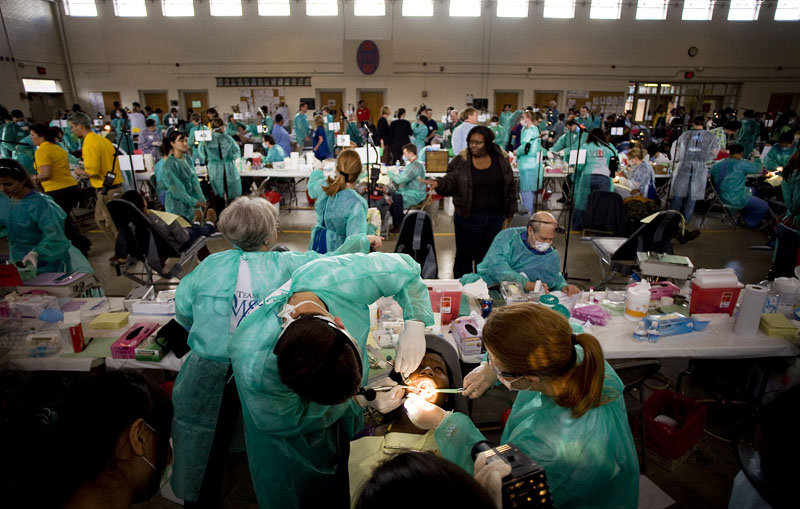
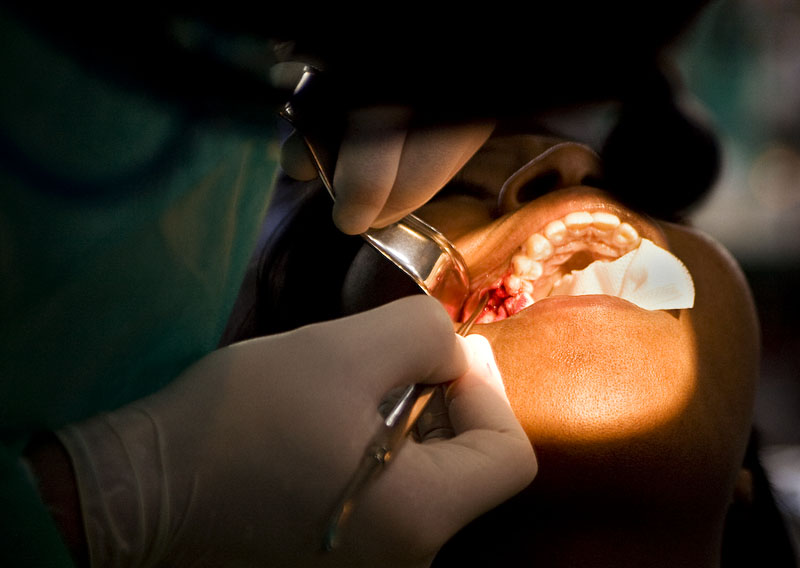
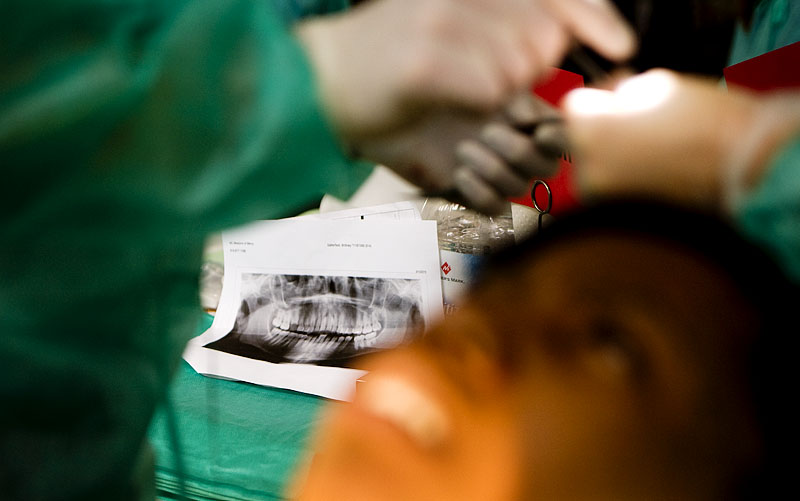
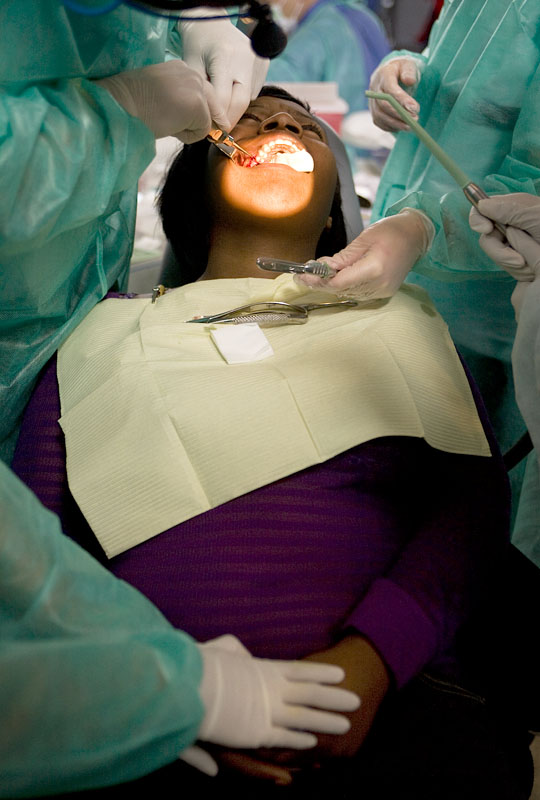
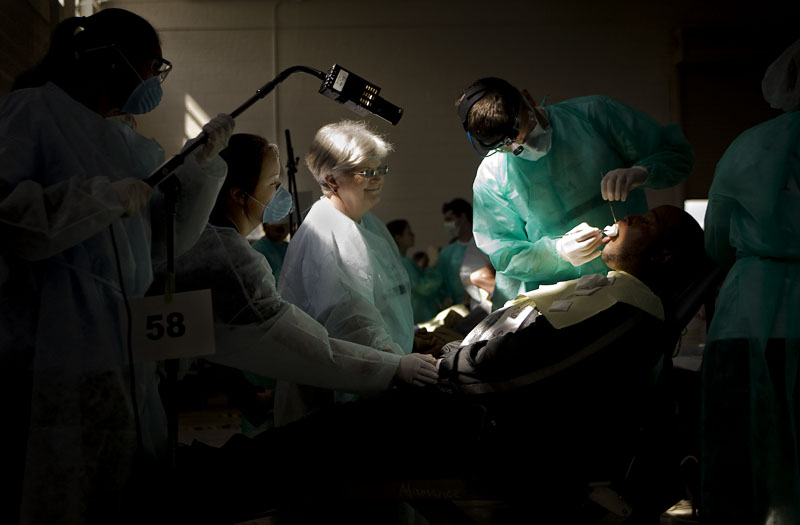
I’m working on a project about health care for my documentary course. I’ve been trying to cover a broad range of topics and one is dental. Dental is often not included in health coverage and is very expensive. People go for years neglecting their dental hygiene even though dental pain can be one of the most nagging and painful injuries to endure.
This two day clinic offered free dental services for patients and performed most dental procedures except root canals. On the second day, people began lining up at midnight to be seen at the clinic, which opened at 7 a.m. It took most people about 8 hours to be seen. Many of the people I spoke with had traveled from rural parts of North Carolina and had not been to a dentist in several years. I was surprised at how happy many of them were to be there even after waiting through the night and having one or more teeth pulled. To learn more about the dental clinics, visit the N.C. Dental Society’s website.